Reaction games on the gates
How Light Chase, Go-No Go, and Choice run on Vitruve Speed, what reaction distance controls, and how gate spacing changes the drill.
Vitruve Speed gates produce the cue as well as measuring the response. Their lights run three reaction games, controlled from the gate or from the app. To record games to an athlete's profile, see Record reaction workouts.
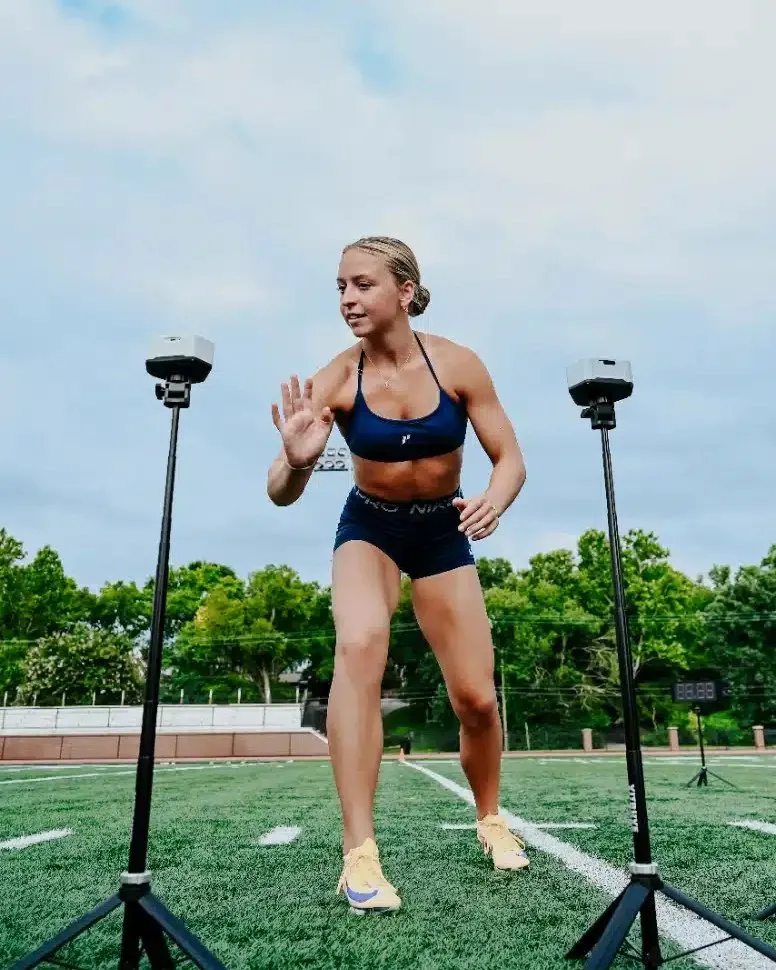
The three games
| Game | What the athlete does | What it trains | Results | Pace |
|---|---|---|---|---|
| Light Chase | Lights fire at random. Hit as many as possible in the time window. | Pure processing speed. | Total hits and average reaction time. | Athlete-paced |
| Go-No Go | Each cue is red or green. Hit green and ignore red. A red correctly ignored counts toward accuracy. | Inhibition and impulse control, not only speed. | Hits, errors, and accuracy. | Device-paced |
| Choice | Several gates, usually four, light at once in mixed red and green. Take green over red as often as possible. | Decisions under a spatial choice. | Hits, accuracy, and reaction time. | Athlete-paced |
Self-paced games show how fast an athlete can go. Go-No Go shows whether they can hold to a standard you set.
Settings
The only settings inside a game are Reaction Duration, and Difficulty (Easy, Medium, Hard) on Go-No Go. Light Chase and Choice have no difficulty setting.
Reaction dist is a detection setting shared by all three games: how close the athlete's hand has to get before the gate registers a hit. The default is 12 in (30 cm), and you can change it.
Gate spacing
Reaction dist is not the distance between gates. The gates do not know how far apart they are, and a reaction drill has no distance value anywhere in the system. That is why reaction games return times and hit counts but never velocity.
Where you place the gates is your coaching decision, and it changes the drill completely:
- Close together, athlete stationary: hands-only reaction. Low physical cost, so it works on a recovery day or in a warm-up. Coaches often call this "brain reaction".
- Spread out, athlete sprinting between gates: full-body reaction, with acceleration, deceleration, and change of direction on top of the reaction demand. Coaches often call this "movement reaction".
The game, settings, and results are the same in both cases. There is no menu option for brain or movement reaction; the difference is only the spacing.
Because the spacing is not stored anywhere, give each spacing its own exercise name in the app. Two spacings logged under one name look like one drill in History. See Exercise library.
Settings and screens
Set Trigger and Role per gate, control detection distance, read the gate's screens, tune advanced settings, and use the external display.
Troubleshooting
Work through a time that did not register, phantom times, a node that stops reporting, indoor interference, and times that seem inconsistent.